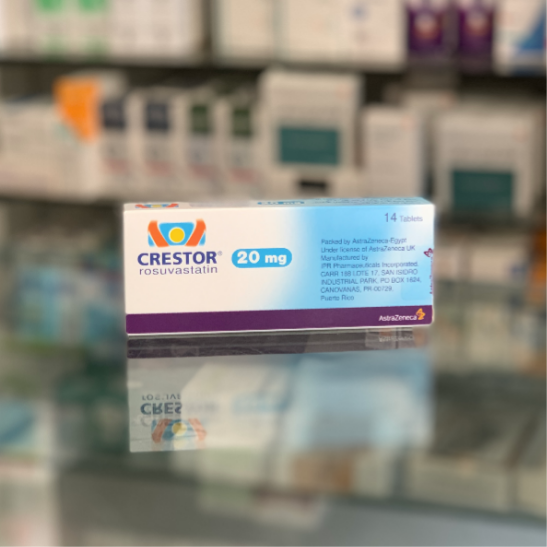
Crestor 20 mg 14 tablets
SKU: EGA-004345
Tradename
Crestor 20 mg
Crestor 20 mg
Compound:
Each p/o tablet contains:
Rosuvastatin — 20 mg.
Auxiliary components:
lactose monohydrate, microcrystalline cellulose, calcium phosphate, crospovidone, magnesium stearate, hypromellose, triacetin, titanium dioxide, iron oxide yellow.
Properties
Rosuvastatin is a synthetic lipid-lowering agent from the statin group, an inhibitor of GMC-CoA reductase. Inhibition of the activity of HMG-CoA reductase leads to a series of successive reactions, resulting in a decrease in the intracellular cholesterol content and a compensatory increase in the activity of LDL receptors and, accordingly, an acceleration of LDL cholesterol (Xc) catabolism.
Indications
treatment of hypercholesterolemia in adults with primary hypercholesterolemia (type IIa, including heterozygous familial hypercholesterolemia) or mixed hypercholesterolemia (type IIb) as an adjunct to diet when diet and other non-drug treatments (exercise, weight loss) are inadequate. Homozygous familial hypercholesterolemia as an adjunct to diet and other cholesterol-lowering therapy, or when such therapy is not appropriate for the patient. To slow the progression of atherosclerosis as an adjunct to diet in patients who are indicated for therapy to reduce the concentration of total cholesterol and LDL-C. Primary prevention of major cardiovascular complications (stroke, heart attack) in adult patients without clinical signs of coronary artery disease, but with an increased risk of its development.
Mode of application:
inside, swallow the tablet whole with water. The drug can be administered at any time of the day, regardless of food intake. Before starting therapy, the patient should begin to follow a standard hypocholesterolemic diet and continue to follow it during treatment. The dose of the drug should be selected individually depending on the goals of therapy. The recommended initial dose for patients should be 5 or 10 mg 1 time / day. If necessary, the dose may be increased after 4 weeks. Due to the possible development of side effects when taking a dose of 40 mg, it can only be carried out in patients with severe hypercholesterolemia and at a high risk of cardiovascular complications, in whom the desired result of therapy was not achieved when taking a dose of 20 mg. Careful monitoring of patients receiving the drug at a dose of 40 mg is recommended. Elderly patients do not require dose adjustment. In patients with mild or moderate renal insufficiency, dose adjustment is not required. For patients with moderate renal impairment, an initial dose of 5 mg is recommended. An increase in the systemic concentration of rosuvastatin was noted among the Japanese and Chinese. When prescribing doses of 10 and 20 mg, the recommended initial dose for patients of the Mongoloid race is 5 mg. Patients predisposed to myopathy. When prescribing doses of 10 and 20 mg, the recommended initial dose for this group of patients is 5 mg.
Contraindications
hypersensitivity to rosuvastatin or any of the components of the drug; lactose intolerance, lactase deficiency or glucose-galactose malabsorption; children’s age up to 18 years; liver disease in the active phase; severe renal dysfunction; myopathy; simultaneous reception of cyclosporine; pregnancy and lactation.
Precautionary measures:
Use with caution in renal failure, hypothyroidism, personal or family history of hereditary muscle diseases and a previous history of muscle toxicity when using other HMG-CoA reductase inhibitors, in chronic alcoholism, in patients over the age of 65 years, with a history of liver disease, sepsis , arterial hypotension, during major surgical interventions, trauma, severe metabolic endocrine or electrolyte disorders, with uncontrolled epilepsy, in people of Asian origin (Chinese, Japanese). When using rosuvastatin at a dose of 40 mg, it is recommended to monitor indicators of kidney function. It is recommended to carry out the determination of indicators of liver function before the start of therapy and 3 months after the start of therapy. The use of rosuvastatin should be discontinued or the dose reduced if the level of serum transaminase activity is 3 times the upper limit of the norm.
Side effects
the drug is usually well tolerated. Adverse events observed when taking it are usually mild and transient. Headache, myalgia, asthenia, constipation, dizziness, nausea, abdominal pain, diabetes mellitus; itching, rash and hives; myopathy, hypersensitivity reactions, pancreatitis; jaundice, hepatitis; arthralgia; memory loss.
Storage method:
Store at a temperature not exceeding 30C in a place protected from moisture and out of the reach of children.
التوصيل والدفع
تأكد من اسم الدواء والتركيز وحجم العبوة. تؤكد الصيدلية التوفر والسعر النهائي ومتطلبات الوصفة قبل إرسال الطلب. لا تغير علاجك اعتماداً على معلومات الموقع وحدها.